
July 21, 2026
36 Minutes
Guests: Ray Moranz
Tags: Staff Guests,
Florida may not be the first state that comes to mind when talking about monarch butterflies. Maybe that’s because much of the conversation about monarchs focuses on their migration and the condition of the overwintering sites in Mexico and California, and so it kind of bypasses the Sunshine State. However, there are reports that monarchs can be seen in Florida all year, and today, we are going to give them their time in the spotlight. We are going to take a journey with monarchs that travel through Florida and explore new exciting technologies to track their migration.
Show Notes & Links
In this episode, we dive into monarch butterflies in Florida and new tools for tracking their movements. Guest Ray Moranz recounts early work with paper tags and describes a solar-powered Bluetooth transmitter from Cellular Tracking Technologies that passively crowdsources detections from nearby Bluetooth-enabled devices. His deployments and others’ show many East Coast monarchs in fall head to Florida rather than Mexico, and spring monarchs from Florida move north to states including Georgia, Alabama, Ohio, Kentucky, Tennessee, and beyond, indicating strong connectivity with the eastern population; timing suggests some April monarchs were locally born from Florida-wintering butterflies. We discuss Florida’s extensive conservation lands, resident monarchs associated with tropical milkweed and higher OE parasite risk, and recommendations to remove tropical milkweed, plant native nectar plants and milkweeds, and avoid pesticide-contaminated nursery plants.
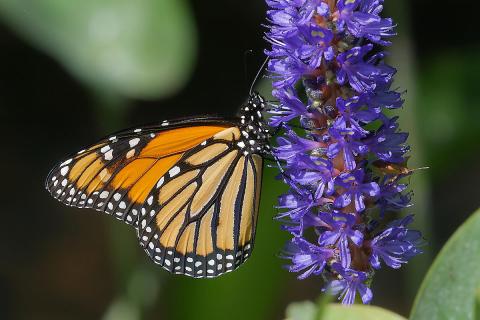
Episode image credit: Dean Jue (c)
Rachel: Welcome to Bug Banter with the Xerces Society, where we explore the world of invertebrates and discover how to help these extraordinary animals. If you want to support our work, go to xerces.org/give.
Matthew: Hi, I'm Matthew Shepherd in Portland, Oregon.
Rachel: And I'm Rachel Dunham in Missoula, Montana.
Matthew: Florida may not be the first state that comes to mind when talking about monarch butterflies. Maybe that’s because much of the conversation about monarchs focuses on their migration, and the condition of the overwintering sites in Mexico and California, and so it bypasses the Sunshine State. However, there are reports that monarchs can be seen in Florida all year, and today, we’re going to give them their time in the spotlight. We are going to take a journey with monarchs that travel through Florida, and explore some new and exciting technologies that are being adopted to track their migration and movements.
Matthew: And who better to tell this story than monarch expert and Bug Banter regular, Ray Moranz. Ray is a Xerces pollinator conservation specialist and NRCS partner biologist based in Oklahoma, where he works to conserve pollinators on rangelands in the central U.S. However, he’s been studying monarchs for even longer, and is probably seldom happier than when he is pursuing an orange-and-black butterfly across the Florida landscape.
Matthew: So, welcome back to Bug Banter, Ray.
Ray: It's great to be here, Matthew and Rachel. Thanks for inviting me.
Rachel: Very much looking forward to learning from you today, because you've spent a significant amount of time studying monarchs in Florida. I'm just intrigued as to what got you interested in that state specifically with monarchs.
Ray: The story goes back 30-some years when I was a graduate student at the University of Florida, and I was lucky enough to be in the laboratory of Professor Lincoln Brower, who was the greatest monarch researcher of all time, acclaimed as such by most of the other great monarch researchers. And he wrote a paper way back then about monarchs migrating to Mexico and California. And in that epic paper—it was 85 pages long—he posed the question: do monarchs spend the winter in Florida, and can they spend the winter in Florida? And he knew that some were hanging out in Miami, in places where it never ever gets cold at all. But what was—he was talking about was Central Florida, North Florida. Do large numbers of monarchs migrate down to Florida and spend the winter? And he concluded no. But at the time I thought, “Geez, what if they're out there hiding in the woods somewhere? Wouldn't it be fun to find them?” But I didn't do anything about it.
Ray: But time goes by, decades go by, and a good friend of mine who's also a monarch researcher who was also in the Brower lab, called me up at Christmastime once. And she was vacationing in Florida, and so was I at Christmas. And she said, "Ray, there are monarchs. There are monarchs out here in the woods. Come out with me and see them." And I did, and it was a revelation. And it was very exciting. And we actually found a monarch that day with a paper tag on it—it had been caught by somebody else. And when we looked around the people who put on tags, it turned out it was tagged in South Carolina two months earlier. And this was December 27th, so this monarch had migrated through South Carolina to Florida. And given that it was between Christmas and New Year's, it clearly wasn't going to Mexico. It was in its winter home in North Florida. So that's what got me started into this, and it's been a labor of love ever since.
Matthew: So let's dive in then. We just heard, you've been aware of monarchs for a long time, and in Florida have been involved with monarch research for a long time, as well. But it's maybe, what? Maybe four years since you've been focusing on them more directly? You know, you're following their movements and their seasonal changes, and so I'm just wondering how did you go about that? Because I know, as well, recently there's been a fairly—a bit of a revolution basically in how you can follow the movement of monarchs. But how are you doing it to start with? And how has this technology changed things?
Ray: Fantastic question. Well, remember a minute ago, I mentioned finding a monarch in Florida with a paper tag from South Carolina. That's the technology I was using for the first few years. I was applying paper tags, circular tags to monarchs. And over 1,000, I think, in a three-year period, and trying to track their movements. But that relied on me driving around and seeing if I could find the monarchs that I had already put stickers on. Or hoping that somebody else found them. I did have some success, but it was hard.
Ray: But last September, a company named Cellular Tracking Technologies up in Cape May, New Jersey released a transmitter that is really fantastic. And it enables people to track these monarchs wherever they go based on crowdsourcing. Very specifically, you put a tiny little transmitter on the back of the monarch. It is solar powered, and it emits a Bluetooth signal. And that Bluetooth signal is picked up by any electronic device that has Bluetooth on—whether the user knows it or not. So if you're driving around the U.S., or Mexico, or Canada and you're listening to some music in your vehicle, and you're using Bluetooth to do that, the Bluetooth in your car or on your phone can detect a monarch with a transmitter, and it'll notify the server in Cape May, New Jersey your location. And therefore we know the location of that monarch butterfly, and we know the time of detection. We do not know your identity—the person with the Bluetooth on in their vehicle. Don't worry about that. We're not spying on you. But yes, we are collecting data on the locations of these monarchs based on millions of people out there who have Bluetooth devices.
Matthew: Oh, that's interesting, because I knew there was a the monarch tracking app you could get on—for your phone. But I had assumed that you needed that app for your phone or whatever to actually contribute data.
Ray: The app is free. I encourage everybody to get the app. And the app enables the general public to track monarchs, but you do not need to have the app on to detect a monarch. And it's really revolutionary technology.
Matthew: That's really interesting to hear about how the technology, how it's a sort of passive way of doing it. I know we're gonna talk a little more about technology, but I'm also wondering where have you been looking for monarchs? Florida is one state, but it's still a pretty big state. Are you looking south, or mid, or north? Where are you hunting around and finding your monarchs?
Ray: Great question. I actually did research this winter in the Florida panhandle, in North Central Florida. And even tried to do some work in South Florida, down near Miami, but I decided not to deploy any transmitters down there. But I was able to find plenty of monarchs up in the northern part of the state, and some in the central part of the state. So yeah, had good luck. And I did put a lot of miles on. I've been to many places in Florida searching for monarchs during winter, fall, and spring. I've seen a lot of the state. And I really love that state. That's a big part of why this research keeps me going. I find Florida's ecosystem is very beautiful.
Matthew: This data you're gathering on the monarchs, do you have any sort of favorite monarchs that you've tracked? Because I understand that you can name monarchs if you want [to] give them a name or just a kind of identifying code.
Ray: Yes. And I have been instructed not to give any cute names. I did name one after me, and that was foolish. Haha. That one didn't—that one went the wrong way. Haha. But on a happier note, even though we're talking about Florida, I have to talk about my biggest traveler, which was a monarch I captured on my farm in Oklahoma last fall, and deployed a transmitter. And that monarch was XSTI for Stillwater. X for Xerces, STI for Stillwater, 009, because it was the ninth one at my farm. And I released it, I believe, on October 8th, and it flew south eventually to Mexico. Spent the whole winter in Mexico. And then on March 8th, left the overwintering colonies in Mexico, made it to the U.S. on March 14th, and then flew through Texas, Louisiana, Mississippi, Alabama, Georgia, to North Florida of all places in late March. So that's my biggest traveler, and what a wonderful monarch she was. That was in the fall. And then again continuing through this spring, which is amazing. We didn't think the transmitters—we didn't—we only dreamed that the transmitters would stay on that long, but they did. They kept on working for six months or more.
Ray: Then this spring there was one named Xerces33UF. UF for the University of Florida. And I captured this monarch at some wildflowers in a garden on the University of Florida campus. Very special to me, because it was about 150 yards away from my office when I was a graduate student at the University of Florida working for Dr. Lincoln Brower. It was neat that I found a monarch there and was able to deploy it. And then it was even better to watch on the app, to watch that monarch migrate all the way north to Ohio. That was my biggest traveler this spring from the University of Florida campus in Gainesville to southeastern Ohio.
Matthew: That is impressive. And with your first monarch, I think it's so cool that it started at your home in Oklahoma, and ended up at your kinda spiritual home in North Florida.
Ray: That is right. And I was actually on the way to Florida when it went there. I did not find it. But I was in Florida at the same time that it was, so that was neat.
Rachel: I don't think I'll ever get over just how incredible it is that these monarchs can fly so far. It's just mind-blowing.
Ray: Yeah. Some fly even farther from the from the maritime provinces of northeastern Canada all the way down to Mexico, and then back to the U.S. So, very exciting.
Rachel: It's really amazing. All right. This is a loaded question. Is there anything new that you've discovered about monarchs in Florida with this new tracking technology?
Ray: Yes. Yes, sure. We knew that some monarchs fly south in the fall through Florida to Mexico. We knew that some monarchs fly from presumably the northeastern U.S. and eastern Canada to Florida, and spend the winter in the Miami area. But I think the transmitters that other people put on in New Jersey and eastern Pennsylvania, and the ones that I put on in South Carolina, Georgia, and Florida—I think it really showed that a very large number of these monarchs on the East Coast are heading to Florida to spend the winter. And I didn't have any—I put on 26 in the southeastern U.S., and I didn't have any that made any sign that they were heading to Mexico. Instead, they either stayed where they were—. A few actually went north from Georgia to South Carolina. But believe it or not, they can spend the winter on the South Carolina coast. That's already been proven. But a whole bunch flew down into Florida. So that's the big lesson number one: a lot of the monarchs on the East Coast in fall are heading down into Florida. Whether that's a good idea for them or not, we'll see, but that's what we found.
Ray: In the spring, knowing that some monarchs spent the winter in Florida, we put transmitters on monarchs to see if any flew back north. These were very likely the offspring of monarchs that spent the winter in Florida—or offspring of monarchs that came back from Mexico. But regardless, put transmitters on [in] the spring, and a whole bunch of those monarchs went north to Georgia, Alabama, Ohio. And then I have colleagues at Eglin Air Force Base in the Florida panhandle, and they had monarchs fly to Kentucky and Tennessee. So yes, we demonstrated fairly clearly that a significant number of monarchs in the spring are migrating from Florida northward to other states. Which is very important because it shows the interconnection, the interconnectivity between Florida and the eastern population as a whole. Instead of Florida being this place where monarchs stay and they can never get out, and they're this single separate population, there's a lot more interchange. There's plenty of interchange between the eastern U.S. and Florida
Rachel: I have this question in the back of my mind that I'm gonna ask. For folks who aren't familiar with Florida—. It's funny because I think, “How could monarchs be hiding in a state and people not know that they're there?” Especially if there's implications that they're overwintering. Can you give us an idea of like how much of Florida is not inhabited by people? Like, how much of it is undeveloped—hard to get to? Can you just give us a sense of what we're working with?
Ray: I'm so glad you asked this, because this is something I think of all the time. That's one of the most exciting things about the story. Because this is the third most populous state in America, right? After California and Texas, Florida is now number three. 18 million people, perhaps. Maybe 20. I don't know, I haven't looked lately. There are a lot of small towns, but of course, huge amounts of people are concentrated in the large metro areas: Miami, Orlando, Tampa, Jacksonville, and many others. I'm very happy to say that about 30% of Florida is public conservation land. 30%. Now, that's a small percentage compared to Alaska, or your home state of Montana, Rachel, but for the East, that's a very high percentage. And many of these areas—I'll visit them and I'm the only person there. And it's me, and the alligators, and the bald eagles, and the occasional venomous snake, and lots of mosquitoes and deer flies. It's probably why there aren't as many people there because there's so many biting flies at some of these sites. But there are monarchs, too. And they've been hiding out. They've been hiding—they've been hiding out in the woods, hiding in natural areas in Florida.
Rachel: So, you mentioned that you placed transmitters on monarchs in Florida this spring. But is it possible that those monarchs flew in from somewhere else before you captured them?
Ray: It is possible that they flew in from somewhere else, or that they are the offspring of monarchs that flew in from somewhere else. And when I deployed monarchs in Florida in May, I think it's quite likely that those monarchs are the offspring of monarchs that migrated back from Mexico. It's quite possible, at least. However, I deployed monarchs on April 11th, April 18th. Those monarchs were brand new. I captured them in North Florida April 11th, April 18th, and they were brand new. They had just came out of their chrysalis. Those monarchs were so new and so fresh, they were almost certainly born locally somewhere in North Florida. And if you look at the timing very carefully, it's pretty much impossible for those monarchs to have been offspring of monarchs that came back from Mexico. Because monarchs started leaving Mexico around March 8th. They didn't get to the U.S. until March 15th. They didn't get to Florida until March 20th, 22nd. They can't have—they can't create offspring, adult offspring three weeks later. The life cycle is longer than that. So those monarchs I found are almost certainly the offspring of monarchs that spent the winter in Florida. So that is very exciting news, in my opinion.
Matthew: Do you think that you might have got different results—I know you did a lot of transmitted deployment in northern Florida. And you mentioned that you had one in University of Florida. If you'd done this in Central Florida, or South Florida, or even the Georgia coast, do you think you would've got the same results?
Ray: I think it's very possible I would've gotten different results. South Florida—especially South Florida. South Florida has lots of tropical milkweed. It's not everywhere, but it's very common in the cities, in people's gardens. And because of all that tropical milkweed, and because these sites never get super cold in the winter, there's potential for monarchs to spend the whole year there. And we have monarchs that are basically in resident populations. Or maybe there's a little influx of migrants, but primarily resident populations. So if you capture a monarch at random in Miami, it's not likely that monarch's gonna migrate north. That monarch is probably gonna just stick around in the neighborhood because it's—that's what it's behaviorally programmed to do. It's lost the migratory urge. In North Florida, not all the monarchs migrated north, to our knowledge, but a whole bunch of them did. It's a very different situation.
Ray: I think the Georgia coast, I would've gotten similar results to what I had in North Florida. But I wasn't able to make it to the Georgia coast this spring. I do hope to be there next spring deploying transmitters—deploying monarchs with transmitters.
Matthew: Yeah. I was thinking that maybe the monarchs just went to Florida just to kinda to retire at that point.
Ray: That's right.
Matthew: They enjoyed it too much, so.
Ray: That's, that's—in a way, that's how those resident populations form. They get down there, and there's all the tropical milkweed they could desire. And I don't really fully understand it. But yes, we've developed these resident populations in parts of South Florida, Central Florida, and even in the cities of North Florida. And these resident populations have built up OE, a parasite, a protozoan parasite that infects monarchs and causes them harm and even death. It's a problem. But I'm happy to report that the monarchs that I placed transmitters on were very healthy. They did not have OE, and they came from populations that when I tested them had very low amounts of OE.
Matthew: So this has been something that's been discussed for a long time within the monarch conservation world. And the risks of OE spreading through home breeding and everything else. Is this possibly bad news if monarchs are maybe migrating from Florida? Are they potentially carrying OE that seems to be well established in the Florida population? Are they potentially moving that northwards and spreading infection to other butterflies?
Ray: That's a fantastic question. I think to some degree, it is. It could be bad news. If monarchs with OE are migrating north, they are carrying that with them and spreading the disease to areas where OE would probably be at a lower infection rate. So they could be increasing the infection rate up north, for sure. Again, I'm happy to report the monarchs that we deployed had no OE and came from populations that were very low in OE. Do the ones with OE migrate north? I don't know, because I didn't test any. I didn't go to the areas that had lots of OE. I didn't place transmitters on monarchs that had lots of OE, or any OE in most cases. But yes, if monarchs heavily infected with OE are heading north, that could be a worrisome thing. And therefore, we at the Xerces Society certainly want people to reduce the amount of OE in monarch populations if they can. And the best way to do that, in our opinion, is get rid of tropical milkweed.
Matthew: Yeah. So it seems like it's one of those questions that has just not been answered yet.
Ray: That's right.
Matthew: I can see speculation, and I can see arguments around it, but at this point we just don't know. We can only say what we do know.
Ray: That's right.
Matthew: Yeah. There's something for someone else, or maybe for you to look into in the future.
Ray: I indeed hope to do exactly that—place some transmitters on monarchs that do have OE, and see how they behave. See if their response is different.
Rachel: Knowledge is power. So all of these discoveries that you've made. And you said quite a few monarchs are possibly overwintering in Florida and migrating north. Do you think this is a new pattern that they've developed? Or do you think it's been happening for a long time? Do you have any sense of what that might look like?
Ray: This is a fun question. Dr. Brower—I mentioned that paper he wrote 30 some years ago. And people actually found monarchs overwintering in Florida in the 1870s. They reported seeing thousands in Apalachicola, Florida, which is a beautiful fishing village on the Gulf Coast. And they reported seeing plenty in Orlando like 80 years ago, 90 years ago. So—. In the winter. So I think it's been happening to some degree. I think it's happening more now due to climate change. North Florida, where I do most of my research, believe it or not—this may sound hard to believe for most of you from outside Florida—but North Florida gets really cold in the winter. There are nights there that get down to the low 20s. Now, that's not cold to a Minnesotan, but to someone from Miami, a temperature of 21 degrees Fahrenheit is too cold to stand. Well historically, it used to get down in the teens in these places in North Florida, but that rarely happens anymore. With climate change, winters are still cool and you still get cold days, but you have a lot fewer really cold days than we used to. And therefore, monarchs are more likely to be able to survive the winter in North Florida and Central Florida than they used to be.
Ray: Ironically, this winter was the cold—we had the coldest day in 40 years! I was in Orlando on February 1st and it was 24 degrees Fahrenheit. It was brutally cold. So that was a rough day for the monarchs of Florida. But yes, I think this has been happening for over 150 years, but I think it's becoming more and more common. And therefore, more and more important that we address the biology and conservation of monarchs in Florida
Rachel: So going back to these Bluetooth transmitters, if one of our listeners is thinking, "Oh, I'd like to get involved in that." Are there ways for people to get involved specifically with that? Should we be having everybody putting transmitters on? What are your thoughts on that?
Ray: If—listeners out there, you can buy these transmitters and deploy them. You can't do it in California unless you have a permit, and there are some other states where that's the case, as well. But in Florida, currently, you could purchase those and deploy those on monarchs. They are expensive. They are $200 each. And then there's a two dollar a month data fee. And then it is difficult to put these on. It's like surgery. Now, I've been handling monarchs since 1992, so I know how to do it. And I've put on a lot of these transmitters, but it's tricky even for me. So I don't encourage our listeners to do this unless they already have a lot of experience handling butterflies.
Ray: And then there's the question of: do you have a research question in mind? If you don't—if it's not gonna contribute strongly to research, then it's not something I recommend. Because it is expensive, it is challenging, and there's a risk that you will harm the monarch as you handle it. If people really want to get involved in it, perhaps they can reach out to researchers who are doing this and assist them with their research. I've had many people help me in the field, and it's been so much fun. Dozens and dozens of people in Oklahoma, Florida, Georgia, South Carolina helping me catch the monarchs, and measure them and weigh them. And I've even let some glue—put the glue on the back of the monarch to attach the transmitter, and things like that. But all under my supervision, of course, because it ain't easy.
Matthew: I know that Xerces staff have also been tagging some monarchs in California to get more insight into how the monarchs are moving around the overwintering areas there. And I've seen the photographs that they have. They have a kind of a field laboratory that they take out, and they set up on the site with all the equipment. And anyway. So it's more than just a case of getting a butterfly, getting some glue, and—.
Ray: That's right.
Matthew: —sticking the transmitter on the back.
Ray: That's right. And of course, our California colleagues have been doing this for years. They're the ones who taught me how to do it. Yeah. And they are pioneers in this field. And our coworker, Ashley Fisher, is actually writing the protocol—the official protocol—that most people will be using to deploy these transmitters. So that's a special honor for her. But yeah, it's complicated. It's not easy. Because you gotta do it right so that you don't hurt the monarch. And we choose really big monarchs. Because if we put them on really tiny monarchs, they might not be able to fly very far. But again, the research, the results we have with monarchs flying from Oklahoma to Mexico and then to Florida proves that these monarchs, at least the large ones, can handle these transmitters. But yeah, not something I recommend for the general public
Matthew: Yeah. So general public, residents, people who live in Florida. What can they do to help? If getting your tags and deploying them is not the best first step to take, are there other things that people can do in Florida to help the monarchs that are there, whether they're all year or passing through?
Ray: Absolutely. First thing I recommend is to get rid of tropical milkweed. Now, I have to confess, I think tropical milkweed is a really beautiful plant. I also have to confess, I've grown dozens of them, maybe hundreds of them over the years. But I've stopped growing them now that I know, now that I know the impact they're having. Very beautiful plant, easy to grow. Monarch caterpillars seem to love it. But it is very strongly implicated in the development of these resident monarch populations, that—in which OE infection builds up to very high rates. So high that it's almost certainly quite harmful to the monarch populations.
Matthew: The connection between tropical milkweed presence and OE. Could you just ex- explain that quickly for our listeners?
Ray: Sure. Sure. OE, of course, is a monarch disease. It's not a plant disease. It's not the tropical milkweed's fault that the monarchs are getting OE. And any milkweed can carry OE spores, but tropical milkweed is a little bit magical in that it's in the Deep South, in most communities of the Deep South, certainly South and Central Florida, it's evergreen in almost every winter. And therefore, monarchs can be using it month after month during winter. And therefore, monarchs with OE can be transferring more OE to the plants. And thereby the larvae that feed on that, those plants are more likely to get OE than monarchs that are on native milkweeds, which are not evergreen. It's not the fault of the tropical milkweed, but unfortunately, the fact that it's evergreen, the fact that it stays in good shape for monarch caterpillars for a long time is actually a negative for the monarch population as a whole.
Matthew: So the OE is on the adult butterfly. And when the adult butterfly visits the milkweed for nectar, or to lay eggs, it—the spores get onto the milkweed. And then the caterpillar eats the milkweed and consumes the spores.
Ray: Yes. We also have to implicate the monarchs, because another main way of transmission is through sexual activity. I believe the males transfer it to the females. And then, of course, the female is infected. When she lays the egg, it is coated with OE spores. So again, while it's not fair for us to blame the plant, we do need to get rid of tropical milkweeds if we want monarch health to improve in Florida and other southern states.
Matthew: And so it's the continuous presence of the tropical milkweed, the evergreen milkweed, that allows the spores to remain. Whereas if you had that seasonal break in growth, then they go—.
Ray: Yep.
Matthew: Okay.
Ray: Yeah, that's right. And the fact that monarchs are using it month after month, yes.
Matthew: So it sounds like not growing tropical milkweed, maybe removing tropical milkweed or cutting it back seasonally is a good step for people to take.
Ray: Yes, absolutely. That's a great step. There are other steps. If you really wanna have monarch caterpillars, consider planting native milkweeds instead. There's a possibility of, like I mentioned before, that the native milkweeds will also carry OE. But it is less than the tropical milkweed because the native milkweeds tend to die back. They're not for the most part, they're not evergreen. Most importantly, we want people in Florida to focus on nectar plants, planting native nectar plants. And you have very many in Florida and the Deep South. And in my research, I've found monarchs using 40 different native wildflowers as nectar plants in Florida. And if I do more research, I'm gonna find even more. And some of these plants are vines, trees, shrubs, or beautiful little wildflowers.
Ray: And by the way, we at the Xerces Society have lists online of the native milkweeds of Florida, and the native nectar plants of Florida. And then this July, I believe, July of 2026, we are going to release a website in which people can type in their ZIP code, and that will provide you with a list of all the native milkweeds, and all the native nectar plants for your ZIP code. So that's gonna be a great tool to use. So yes, we encourage people to stop planting tropical milkweed. We want you to plant more nectar plants for monarchs to feed them during the migration, and while they're there during winter.
Ray: And by the way, don't forget to ask your nursery what they're spraying on the milkweeds. Because our pesticide program has proven through research that lots of the nurseries are selling milkweeds, or nectar plants, with high amounts of insecticide. And those insecticides might be high enough to harm monarchs. Actually, research at the University of Florida has proven that some of the milkweeds sold in Florida are so heavily contaminated with insecticide that it kills monarch larvae.
Matthew: That's just a crazy situation, isn't it? Here's a plant being marketed and sold to you as: "Buy this. Plant it in your garden, help monarchs. But, oh, by the way, we didn't tell you, it's actually gonna kill them."
Ray: That's right.
Matthew: It's like, there's this—. Yeah. Wow.
Rachel: Well, Ray, this has been really wonderful. I've learned a lot, and I know that you've been doing research, but It's great to sit down and be able to ask you more questions. So I'm excited because we've had you on multiple times, but I discovered that we, in our last two questions, have not asked you yet: that if you could see any bug in the wild, which bug would it be and why? So I am like extra anxious to hear your answer to this question.
Ray: I have two answers to that. I have an adventurous spirit, so I like to discover things that are really the unexpected. So I would like to be in Oregon—with you guys—out in the field, and for all of us to rediscover the Franklin's bumble bee. Because to my knowledge, that bumble bee hasn't been seen in over 20 years. But wouldn't it be fun if the three of us and our coworker, Rich Hatfield—who's a bumble bee expert, of course—we're all hiking out in the Cascades, and found a Franklin's bumble bee again. A bumble bee that hasn't been seen in over 20 years, I believe. That would be wonderful!
Ray: Secondly, I'd like to see a Queen Alexandra's birdwing, which is the largest butterfly in the world. And if I'm seeing that in its natural habitat, I believe that means I'm in Papua New Guinea, and that would be a pretty cool place to go. Papua New Guinea, north of Australia. Those are the two insects that I'd most like to find someday.
Matthew: I think you're the first time we’ve had that answer, which has been to rediscover something that may have gone extinct. Which is just—I'm like, “Yeah, excellent.” I love that. All right, so very last question is if you could sit down with any conservationist, living or deceased, who would you choose and why?
Ray: I—. Some nameless conservationist. I really wanna thank the people—I have no idea their names—who decided decades ago to protect so much public land in Florida, especially northern Florida—the areas where I do my research. It was very thoughtful. Those people showed so much foresight, because those areas are wild and wonderful, and they're hosting monarchs. But the other conservationist that I can name would be Professor Lincoln Brower, who in addition to being a fantastic researcher, also worked hard on monarch conservation. And I think he would be just tickled pink to be at these sites with me, and deploying transmitters on monarchs, and watching them fly north. Or to be visiting overwintering sites in Florida. He predicted they weren't—they didn't exist in large numbers. But he'd be thrilled to see that they actually—that there are overwintering colonies in Florida where the monarchs are healthy, and aren't heavily infected with OE. He would love that. And it would be fun to be there with him. He was like a sort of a grandfather figure to me, and I have very fond memories of being in the field with him.
Rachel: Those are all lovely answers, Ray. Thank you so much again. It's always a pleasure to have you on Bug Banter. We really appreciate your time today. And I look forward to hearing about your research in the future. And going on and looking at some of those monarchs migrating and seeing what they're up to. It's so cool that we can do that now. So, very exciting. Thank you so much.
Matthew: Bug Banter is brought to you by the Xerces Society, a donor-supported nonprofit that is working to protect insects and other invertebrates—the life that sustains us.
Matthew: If you are already a donor, thank you so much. If you want to support our work, go to xerces.org/donate. For information about this podcast or for show notes, go to xerces.org/bugbanter.