
April 21, 2026
36 Minutes
Guests: Katie Harris
Tags: Staff Guests,
Few beetles are revered as sacred, seen as a symbol of rebirth, represented in ancient art, and to this day are used commercially for waste disposal, but dung beetles are. And if that’s not impressive enough they use the Milky Way to navigate. Truly amazing animals.
Show Notes & Links
In the episode we take a deep dive into dung beetle life history with Katie Harris. We describe distribution, key identification traits, variation in coloration (including iridescent “rainbow” dung beetles), and sexual dimorphism such as male horns and alternative mating strategies. The conversation covers dung preferences, three main nesting behaviors (rollers, dwellers, tunnelers), rapid odor-based location of dung, and navigation using cues including the sun, moon, polarized light, and the Milky Way. They discuss parental care, overwintering, lifespan, dung theft (kleptocoprids), and their conservation status.
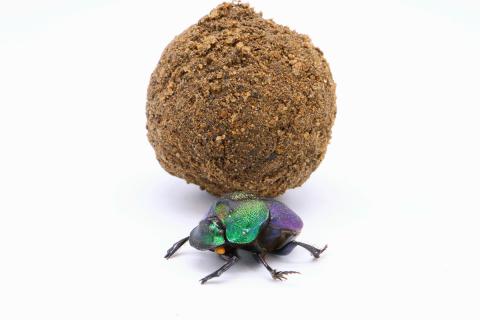
Episode image credit: Katie Harris (c)
Rachel: Welcome to Bug Banter with the Xerces Society, where we explore the world of invertebrates and discover how to help these extraordinary animals. If you want to support our work, go to xerces.org/give.
Matthew: Hello, I'm Matthew Shepherd in Portland, Oregon.
Rachel: And I'm Rachel Dunham in Missoula, Montana.
Matthew: Few beetles are as revered as sacred, seen as a symbol of rebirth, represented in ancient art, and to this day are commercially used for waste disposal, but dung beetles are. And if that’s not impressive enough they use the Milky Way to navigate. Truly amazing animals.
Matthew: To dig a deeper into the lives of dung beetles, we are joined today by Katie Harris. Katie works for the Xerces Society as a pollinator conservation specialist and NRCS partner biologist in Texas, where she works to conserve pollinating insects, with a focus on monarch butterflies, across the state. Katie has a MS degree from the University of Wisconsin-Green Bay, where she studied the biodiversity of spiders. She then began investigating and creating effective monarch butterfly habitat, and in 2023 graduated from the University of Missouri with a PhD. And that led to a position as a postdoc researcher at the University of Texas at Austin examining the effects of parasitism on dung beetle behavior and ecosystem services in central Texas.
Matthew: That's a pretty impressive background—and diverse, too, so. Anyway, welcome to Bug Banter, Katie.
Katie: Thank you so much for having me.
Rachel: Yeah, we're super excited to have you here. I'm really excited to learn about dung beetles today. So let's start with the distribution and diversity of dung beetles. Where can you find them? Are they found all around the world? Are they only found in certain ecosystems?
Katie: Yes, so dung beetles, they can be found on pretty much every continent except Antarctica. And their habitats can range from dense forests to open pastures and open fields, from hot dry deserts to the dog poop in your backyard. Haha. So they are quite varied, and it's actually quite wonderful that we have them everywhere.
Rachel: That's amazing. And how many different types or species of dung beetle are there?
Katie: Worldwide there's approximately 9,500 species.
Rachel: That's more than I expected. And how many of those are found just in the U.S.?
Katie: Yes, out of those 9,500, approximately, like about 90 species are present in the U.S. Although I wouldn't be surprised if there are actually more that just haven't been described or found yet. Insects are quite diverse. There's so many of them. And relatively speaking, they're a little bit understudied, so I bet there's some more out there that are waiting to be discovered.
Rachel: It just blows my mind when I hear about people discovering a new insect that hasn't been seen before. So [I’m] like, “I wanna go find a dung beetle that no one's described yet.”
Matthew: Yeah, no, and I was thinking when you were answering the question about where they're found, in my head, I'm thinking, “Oh, wherever there's dung.” And it turns out that's essentially anywhere that there's enough food for them. With all that diversity, do all dung beetles look the same? Are the different colors, different sizes, different shapes?
Katie: Yeah, so I think when most people think about dung beetles, they think about these like small, dark, black or brown beetles, either pushing dung or sifting through dung of a similar color that they are, right? And the vast majority fit into that category of small, dark brown or black beetles. However, there are some that are really beautiful. Like the rainbow dung beetles. They can range in color from reds and greens to purples and blues, and they're really quite iridescent and jewel like, and they're very beautiful.
Matthew: We typically think of the black things. But I know that some of them are remarkable colors, and have been used for decorations over the years, too, just because of that iridescence. But if I was out there and I was looking at beetles, are there distinctive features that would help me identify one beetle is a dung beetle rather than something else like a ground beetle or a lady beetle?
Katie: That's a great question because beetles are of the most diverse order of insects on the Earth. And so identifying their species can be a little bit difficult from others. First, their behavior will be a really great clue. So if they're in and around dung, that's the first good start. But there are also some anatomical features, as well, that you can look at. The dung beetles tend to be a little bit more compact and round looking, and they also have these really strong front legs that they use for digging. And they have what are called tibial teeth on the outer edge, and they use those for digging tunnels into the ground. And they also have—their clypeus on the front of their face is also shaped in an interesting way to help them maneuver dung and to help them dig tunnels, as well. So it's kind of shaped like a shovel, or like a trowel. So it's kind of like if we had like a giant spoon, or like trowel on our face. Haha. Sometimes it looks a little bit different, there'll be like different structures on it, but usually it's like very disc-shaped, and they use it to the maneuver and dig through the soil, which is really cool.
Katie: And then, maybe a final feature that would be helpful are the antennae. So antennae of dung beetles are described as lamellate, so they look clubbed. But they have these plate-like folding structures. When they're trying to sense chemicals or pheromones from females, they can expand them out a little bit, and that allows them to take in those volatile compounds to smell. And then when they're digging, they can like retract, or like push them together to protect like the sensitivity inside. So when they're digging they look more like kind of clubs.
Matthew: Yeah, I'm old enough to remember cars with spark plugs. And you used to have to go through and check the gap in the spark plugs. And what you're describing there—. You have these little sets of flat metal plates that were different thicknesses, and you could splay them out, and then close them over. And that's how the dung beetle antennae are, too.
Matthew: Are there differences between male and female dung beetles? I've seen some photographs, and there are some dung beetles that have a tall—like a horn sticking out the top of their head. Is that a gender thing or a species thing?
Katie: Yes. So, not all of the species display sexual dimorphism, which is when they look different—males and females like physically look different—but some dung beetles do, which is really cool. And the sexual dimorphism in dung beetles appears as the males having horns, and the females typically lacking horns. And the horns can be on the dung beetle’s heads, or they can be on their pronotum, which is kind of like the sclerotized region above their thorax. And there's also dimorphism within the males, as well. So some horns—there's like a range of horn lengths—some horn lengths are really short and some are a lot longer—and those tend to be larger beetles. And the smaller ones are called minor males, and the larger ones are typically called major males.
Matthew: And is there a reason or a benefit to having a different size of horn, or a benefit to having a longer or shorter horn? And do they use the horns for anything in particular, or is it just to say, “Hey, look how big my horn is?”
Katie: Yes. So the horns do play a role in like sexual selection, and mate defending, as well. So the larger males with the larger horns tend to win in confrontations with other beetles for like a female access, and protecting their own tunnels. The larger major males that have the large horns and tend to win have more of a competitive advantage than the smaller minor males, right? So these smaller minor males, what they'll do is oftentimes they'll sneak into a burrow already made and claimed by a major male when the major male's back is turned—they're collecting food or something—and this minor male sneaks in for a mating opportunity. I've also heard of instances where the minor males will tunnel—make an additional tunnel, like to reroute back to that female—and sneak a mating opportunity in that way, as well. So there's workarounds for the minor males that are at a competitive disadvantage to those big, flashy major males.
Matthew: Yeah, no, that's great. I've now got this picture of this minor male burrowing down over here, and then mining underneath to sneak up, so.
Katie: It's like a movie, right? Like a spy movie. Haha.
Matthew: Yeah, exactly. But escape in and not escape out.
Matthew: Do beetles have like dung preferences? Because I know like with bees, some bees prefer certain types of flowers. Are dung beetles like that? Are they like dung connoisseurs, and they need a particular species of mammalian dung or something?
Katie: Yes. So, dung beetles, in general, appear to be generalists, where they'll feed on many different types of dung. There are some examples of sort of specializations, and like co-occurrences. And for example, the rainbow dung beetles in America tend to be found more in open pastures, cattle dung. However, dung beetles, in general, do appear to have a preference towards pig and human dung. It's very interesting. And a lot of like the research that's been conducted in the tropics, actually the researchers use human dung because number one, it's readily available, and number two—. You don't have to go out and collect from the cows and like bring it in. Haha. And number two, the beetles love it, and it's very attractive. If you're looking to try to identify a species from a dung type, that really wouldn't be too possible. You'll have to look at it under a microscope.
Matthew: No. Huh. That's fascinating, because I've always thought of dung beetles, they’d be like with a cow pat or, in Africa, where I was for a while, it's, “Oh, elephant poo,” and you go out, there’d be the dung beetles. I never—hadn't really associated them with people, which is—. But there's people everywhere, so it makes sense.
Rachel: So I wanna dive into talking about their behavior. Why do they roll dung?
Katie: Yes. That is a great question. So dung is this wonderful resource that's ephemeral in nature, right? It's not always there. They have to like search and find it, and it disappears really quickly, mostly because it's not highly defended, right? This pile of dung isn't like plant material, where an insect is trying to eat the plants, and there's chemical defenses or there's structural defenses trying to prevent it. This dung pat is essentially this little pile of gold to these little dung beetles. Haha. So getting there first, and grabbing what they need and getting out is like really important to avoid competition. So they wanna take their resource—nice, fresh resource—and move it away from this highly attractive resource that everyone's going towards in order to preserve it for themselves.
Rachel: And do all dung beetles roll dung?
Katie: No, not all of them roll dung. There’re actually three primary nesting behaviors that are often cited. The rollers—which are also termed as telecoprids—they're the ones who grab the dung and they roll it away. They either roll away food balls, which tend to be a little bit smaller and bury those for themselves, or larger balls, which are—they make into brood balls, where they lay—a female will lay one egg in each brood ball, which fully provisions all of the resources the young needs to turn into an adult. And the second type are the endocoprids, or the dwellers. And those dung beetles tend to stay in the dung pat itself, or towards the bottom of the dung pat. And then there are also the tunnelers, which are the paracoprids. And those beetles, they will find the dung pat, they'll burrow under it and they'll create a series of chambers for food burial, and for their brood balls a little bit deeper, as well.
Rachel: Wow. It's so interesting. They really use it for everything. So resourceful. And then how do dung beetles find their food? And how far away can they sense that there is dung?
Katie: Yes. So they use those lamellate antennae. There’re chemoreceptors in there to pick up on what are called volatile organic compounds, or chemicals that the dung is releasing. And so, kinda like smelling, I guess. They use their antennae to smell, and they'll locate—. They can locate these dung pats really quickly depending on how close they are already to the cows, or like the animals. I've seen dung beetles land on dung pats within like seconds, like 15 seconds, 30 seconds of it being like deposited by the large animal. Haha. In like a really healthy ecosystem where dung beetles are flourishing, they can be really quick. And then in terms of how far away, that can range by the species. So they can detect from hundreds of meters up to miles away.
Rachel: Wow, that's so impressive. This is a really gross example, but it makes sense, as you were saying in that earlier study, that dung beetles actually prefer human feces. Because I just think about our dog, and he's only rolled in poop one time, and it was human. He found it at a park, and it was the most horrific experience. If anybody out there has had this happen, it was awful. We had to give him so many baths. And it took months for the smell to get out because the smell is so strong. If scent is any part of being an attractant, then yeah, they would probably like human feces, which is just so disgusting. Haha. But yeah, that makes sense. So once they get the dung, how do they know which way to roll it?
Katie: Yeah, that's a great question. Especially considering that they tend to roll their dung balls in a relatively straight line, to be honest. Which, like if you drop me off in the middle of a dense forest or in the middle of an open field, I don't think I'd be able to walk in a straight line, to be honest. So like, how do these little dung beetles do it, right? So if you're watching some of these dung beetles rolling their dung, you'll notice that they push the dung ball from backwards. So they use their hind likes to push it. And then every now and then they'll stop, and they'll stand on top of the dung ball and they'll look around and orient themselves. So essentially, they use a series of environmental cues to help decide which direction is the correct direction to go. And these cues can range from the sun, the moon, polarized light, and even the Milky Way, as Matthew had mentioned in the intro, yeah. The Milky Way experiment is like really cool, too. Researchers actually stuck them in a planetarium, and the researchers believe that the beetles are probably not likely picking up on individual constellations, but they're using that light to dark patterning to determine like their direction.
Rachel: That's really amazing. What other interesting behaviors do dung beetles have?
Katie: Yes. So, at the risk of anthropomorphizing them too much, they sometimes look inquisitive, and they're just like—really they're a treat to watch. You should watch them sometime. They're like really cute. Haha. But they do have this really interesting—and kind of unique to the insect world. There aren't too many insects who exhibit this behavior—so the dung beetles exhibit this parental care. It is usually very costly to be a parent in the insect world. The dung beetles, the pair, will often work together to prevision their young with all of the food that they need in order to become an adult. So those brood balls we talked about earlier, that's just essentially a giant ball of dung that they have layered a little bit of soil on the outside of. And the females actually have like antifungal properties in their saliva, oftentimes, that they like apply to help protect this wonderful resource that they work so hard to provision for their young. They'll lay one egg in it, and the egg will hatch into a larvae and pupate. And the emergence from the brood ball is an adult at the end.
Katie: And then females, they actually have been known to protect and stay with the brood ball for up to months at a time, to help guard it and make sure that there's no like fungus growing on it. And if any of the walls become breached in any way they could re-patch it to sort of help prevent desiccation and drying out.
Matthew: Do you mind if I jump in with just one detail question? Because, it's when you're talking about burying the brood ball, and the parental care—it also makes me think of burying beetles. And they help digest their food supplies so that their larvae can drink it up. Do dung beetles do that, as well?
Katie: Dung beetles do a little bit different. The adults actually have a little bit softer mouth parts, I guess you could say, where they are mostly drinking like this microbial slurry off of the dung. They're eating the easier to process sorts of, parts of the dung. And the dung that they provision for their young has a lot more fibrous material in it. And the larvae actually have more sclerotized, like harder mandibles that are able to get through. So they're not necessarily making it easier for the larvae, but they're not making it hard on purpose either.
Matthew: So, that's interesting because the baby eats the solid food, and the parents are on the liquid. Oh, fascinating.
Katie: Yeah.
Rachel: That's so interesting. The parental care is wild, especially both the male and the female showing parental care. I just, I have a quick question, as well. How many brood cells do they make? Like how many balls of dung, how many offspring can they make? Because I imagine, like you said, it's very costly.
Katie: Yes. So to my knowledge, typically like, two to five, under a given dung pat. That being said, each dung pat might host a different amount. Haha. It is gonna be dung-limited likely. There's a dung pat, and the tunnelers are taking dung under the dung pat and provisioning food off in like side chambers, and then taking that down to form these brood balls. They might be slightly dung-limited. I think, typically, at least for the rainbow dung beetles, it's around three to five brood balls. But then, say they emerge and go to another dung pat, there's more opportunity for more.
Rachel: And I'm assuming dung pat is just a fancy way to say a pile of dung.
Katie: Oh yeah. A pile of poop, yes. Haha.
Rachel: Okay. That's why I just wanted to make sure. And then in terms of where they spend their time, what do dung beetles do in the winter time?
Katie: Yes, that is a great question. I was actually asked this the other day, and it's a great question because insects have so many different ways of avoiding winter and the cold. So it really does depend on the type of insect we're talking about. Some insects, they just straight up try to avoid the winter by migrating—kind of like monarch butterflies. And others, they will produce these like chemicals that are essentially antifreeze, and they'll actually prevent themselves from freezing, which is very cool. And others will go into dormancy, which is like reduced activity. They're not growing or anything like that, or reproducing. And dung beetles typically fall into the category of going into dormancy. They'll tunnel underground. They'll either overwinter as adults or in the brood balls, and emerge in the springtime. But, I would say, generally, for most of the United States, dung beetles will oftentimes just overwinter underground. There are some dung beetles that are still active in the winter, and they can handle some of the colder temperatures. But for the most part, underground.
Rachel: I have two quick follow up questions, if that's okay. One, how long is their lifespan?
Katie: Oh, yes, that varies by species, as well. Some of like the smaller dung beetles—. Digitonthophagus gazella. That one is a very small tunneling species. It can start as an egg and become an adult within a month. Some of the larger tunneling species in America, like the Phanaeus dung beetles, the rainbow dung beetles, they could be in their brood balls for anywhere from a month to multiple months, especially if they're overwintering in the brood balls. But in terms of lifespan, I would say typically for the larger tunnelers, like Phanaeus, it's around a year, or maybe two. I'm not sure that there's too much like in the literature at the moment for like exact numbers between all the species, but generally speaking, around a year, maybe shorter for smaller species.
Rachel: Yeah, that's what I was thinking. So, my other question is you talked about the beetles that will find a pat—dung pat—and burrow underneath. But you also talked about the ones that roll the dung away, because it's this precious resource and they wanna make sure to protect it. Are there like beetle wars for certain beetles that find a dung pat, and they're trying to like outcompete the others for tunneling under it? Haha. I'm just trying to like—. It's just so—. I'm—. You're like blowing my mind with all this information. Haha. I'm like—. I just wanna understand, are there certain aggressive behaviors? Like does that happen where they're trying to fight over this dung pat?
Katie: Yeah. Especially with the rollers, you'll sometimes see dung beetles trying to steal each other's dung balls that they so carefully grabbed, right? And started painstakingly rolling away. There's also what are called kleptocoprids. And these beetles are seen almost as like a fourth category of nesting behavior. And as the name implies, kleptocoprids, they're—they steal another dung beetle’s dung. So they'll either like sneak into their tunnel and use it for themselves—lay their own eggs in it—or they'll just steal it like from a roller, and use it for themselves. But yeah, kleptocoprids is a fourth category.
Matthew: I'm glad you asked all the extra questions, Rachel. Because I'm sitting here, “Oh, here's a question.” And I was like, “Oh, Rachel has it. So that's great.” The more we talk, you suddenly realize there are these details that you hadn't considered before. Just so that we learn more and more about these incredible creatures.
Matthew: So you were doing research, studying parasitism on dung beetles, behavior, and the ecosystem services. Can you tell us about this?
Katie: Yes, absolutely. So when I started at UT Austin as a postdoc, there was some research that already had come out through the University of Tennessee where they found that these tunneling dung beetles, under warmer conditions would bury their dung—the brood balls—deeper into the soil. And there were also some studies out of the Colorado State University that showed that parasitism, like nematodes inside of these dung beetles, were affecting their burial behavior, as well. And they would bury the dung more shallowly if they were parasitized by these nematodes. So what I wanted to do was look at how both of these factors—warmer temperatures and parasitism—interact to affect dung beetle behavior and ecosystem services.
Matthew: I'm sure most of our listeners know what a nematode is, but could you just tell us what a nematode is?
Katie: Oh, yes, so a nematode—when I say nematode, I mean like a small worm. So, as you can imagine, dung beetles interact with dung and oftentimes animal dung in the wild is a little bit wormy. Haha. There’re some parasites in there. Particularly like feral hog dung is known to have quite a bit of parasites in there, and whatnot. And it's very interesting though that researchers have found that these parasites can actually affect these beetles’ behaviors just by being parasitized.
Matthew: Yeah. And that's where the beetles get the parasites from. So that it seems like the nematodes—and I know we're not talking about nematodes—but they must pass through the gut of the host mammal in order to be in the dung, where the beetles will pass through.
Katie: Yes. They're kind of like an intermediate host, yeah.
Matthew: Yeah. Oh, cool. So what did you learn from this?
Katie: Yes. The manuscript is still in production, but I can give you a few of the results. In general, it appears as though the parasitism might exacerbate the negative effects of warming on the dung beetles themselves. The sample sizes for our brood balls in the experiment were a little bit lower than I would've liked. It's very challenging, sometimes, to work with research projects with insects that you're studying—their behaviors and whatnot—in a more controlled setting. As I mentioned before, breeding dung beetles can be quite challenging, as well. So I have these large tunneling beetles, the rainbow dung beetles—they're the ones that I'm working on—and they can bury their brood balls like 60 centimeters into the soil, so like a couple feet. They also need that space from one another, as well.
Katie: So in like commercial settings, these large tunnelers, it's really hard to breed them. And some companies—there's like a company in New Zealand, I believe, who commercially produces dung beetles for, I believe, farmers’ use and ranchers’ use. Because dung beetles are very beneficial. But in terms of getting enough of these beetles, it takes going out and collecting dung in mass, and spending tons of time outside to try to catch these beetles that aren't incredibly prevalent and numerous. So there was a little bit of challenge with trying to get as much replication as you would like in an experiment. But in general, what we are seeing within the data is that the dung beetles that were parasitized and in warmer conditions—so both of these factors together—they lost weight, and they produced brood balls that were smaller. And they were buried more shallowly than if they were not parasitized and under warmer conditions.
Matthew: Do you know if there's a relationship between warming and the prevalence in the nematodes? In warmer conditions, will there be more nematodes?
Katie: Yes. That is a great question. I don't know specifically, like exactly, however there tends to be higher—. So like especially in insects, when you have warmer temperatures, growth, and development, and reproduction can happen faster. So I wouldn't be surprised if the warming itself could also have an impact on nematodes. One of the major mechanisms of spread of some of these nematodes that I have been studying could potentially be through like feral hog expansion. So feral hogs are an invasive species, they have been expanding in territory rapidly. And they could also be helping to transmit nematodes across the landscape, as well.
Matthew: Oh, yeah. And you already said that hog dung was one of the ones that beetles, these dung beetles seem to prefer, so—.
Katie: Oh, they love it.
Matthew: —it's like an unfortunate feedback loop. More hogs, more nematodes, more good dung. Yeah, unfortunate. And you were talking about collecting beetles. Was this a lab study? Did you do it all—? Or did you do it like in a greenhouse, or something? Or were you just chasing these around out there on the prairie?
Katie: Yes, so I did collect the beetles from a longhorn herd, actually a pasture out west of Austin. But I did do the actual experiment in mesocosms, so like large buckets, like very large buckets. Haha. So I used the Texas Soil Observation Network data to base my temperatures for control off of, and then also set half of the buckets, or mesocosms, to warmer conditions, as well. And so these were done inside.
Matthew: Yeah, no, that's great. No, I'm just always intrigued on how this research gets done. Just the creativity of the researchers in order to be able to control the conditions that then you know that your data coming out is more reliable. But so you've got these results. How did these results translate maybe into dung beetles and their ecosystem services?
Katie: Yes, absolutely. So, we saw that there were some negative impacts from both warming and from parasitism in these beetles, right? Beetles that are losing weight, that could affect their survival, that could affect their competitiveness, and their ability to provision for their young. Along with lighter brood balls means a smaller dung beetle that comes from that brood ball, which is also a less competitive beetle, as well, and less provisioned. It could also affect their survival, as well. If the brood ball isn't provisioned enough, the young might actually not develop into an adult. And then these more shallowly buried brood balls could be an issue because they're less protected against just the natural temperature variation that you have. And that also affects their survival, as well. So these negative stressors working together don't necessarily equal immediate like death or anything within the beetles. However, over time, this could really affect their abilities to be competitive, and survive, and keep providing us with those ecosystem services that are so important.
Matthew: Yeah. So maybe in the future fewer, smaller, less active dung beetles, and therefore more dung on the surface, right?
Katie: Yes.
Matthew: And with that, I'm also thinking of Australia, and that classic image that came from Australia of the cork hat. Because of the introduction of European livestock to Australia, and they didn't have the dung beetles to deal with the dung, and they ended up with too many flies.
Rachel: So this is a perfect segue into my next question. What ecological role do dung beetles play? Why are they important?
Katie: Yes. Without dung beetles, we would have a lot of dung built up, and it would last on the surface for longer. They do this wonderful ecosystem service of removing all of this waste that we typically don't like to interact with as humans. Haha. They remove this waste and they recycle it back into the earth. So they make more nutrients available to plants, and they help aerate the soil, which is great for water infiltration, and plant root growth. The actual act of burying the dung, it puts a lot of those nutrients back into the soil, and reduces methane emissions. And then when they're actually digging through the dung, they're actually helping dry out the dung pat, as well, which will reduce the ability for certain types of like flies, and pests, and pastures from reemerging. And as well as the buried dung actually helps with reducing pest pressure on pastures, as well.
Rachel: Dung beetles are so cool. So what can folks do to conserve dung beetles?
Katie: Yes, so dung beetles are—we believe they're in decline, and there are a couple of factors that are leading to that, including habitat fragmentation, habitat loss. One of the biggest things right now though is we're actually accidentally creating these traps for the dung beetles. So a lot of dewormers that are used on animals, they end up in the dung. And these dung beetles are lured into this dung, only to consume poison, essentially. So like Ivermectin and different types of dewormers can harm dung beetles directly by killing them, or even at very lower concentrations, they can affect the dung beetle’s locomotion or movement, and their ability to smell, and also like their larval survival. Trying to limit the use of these is really great.
Katie: So if you own a herd of cattle, or you have lots of like large herbivores that you're giving Ivermectin, it would be worth it to look into integrated pest management strategies. Integrated pest management being that there's other nonchemical options that you can also use. So you can still keep your herd healthy, but there are other strategies, like maybe lower intensity grazing, and rotating your cattle more often could help prevent these cows from being in the same area as they're dung, which would help with parasites, like avoiding parasites in your cattle.
Katie: And also like having a diversity of wildflowers and forbs on your pastures can also be beneficial, because they'll recruit in all of these natural enemy insects that will help kill different types of pests on your pastures, like corn flies. And it's just a win because cattle actually can get a lot of nutrition from a lot of these forb species, as well.
Katie: In terms of what people who don't necessarily have a herd of cattle can do to help. Haha. We're thinking like—. A lot of times some of the insecticides you just use on your lawn could be harmful to these insects, as well. If you have a new puppy that you're giving a dewormer to, maybe be a little bit more mindful of where that dung is ending up.
Matthew: Yeah, no, I'm glad you shifted to what people who don't have a herd of cattle could do. Because I was thinking like it’s so often that the conservation tips—and we always like to wrap up with some conservation tips—it's, “What can you do in your home garden, or your neighborhoods?” And I'm not gonna go ‘round and put more dung in the garden. Just—I think we might get some complaints if we start telling people to put dung in your garden. It'll be a difficult one to get past the HOA, I think.
Matthew: But anyway, so, Katie, thank you so much. This has been a delight to talk with you, and to learn more about beetles. And the fact we kept peppering you with more and more questions [is] an indication [of] just how interesting and engaging this has been. So thank you for that. As we wrap up at the end, we have our last two, kind of standard questions that we like to ask people. And the first of those is: what inspired you to get into insect conservation?
Katie: Yes. So, I actually, when I started college, I wanted to be a veterinarian. So I was pre-med for a couple of years. But I watched a surgery, and pretty much passed out. A little squeamish. Haha. So I switched majors, and during my undergrad, I was able to go on this research trip to Panama to collect spiders in the Panamanian rainforest. And I was actually terrified of spiders at the time, but I really wanted to travel. So, you know, here I am in the Panamanian rainforest with my hood over my head because we're like banging on trees to see what falls down, and we're sifting through leaf litter to see what pops out. And you know, I just really, I don't know, it changes you a little bit. And now I get to interact with these—and like advocate for—these little animals that make such an impact in the world. And I wouldn't have been able to if I hadn't gone on a trip like that, and interacted with arthropods, in general, like up close and personal. Haha.
Rachel: I love that visual of you in the forest banging on trees. Haha. Well, good on you for doing it despite your fear of spiders. And then our last question—if you could see any bug in the wild—bug being a very loose term—what would it be and why?
Katie: Oh, man. So, I feel like I've already seen the most pretty dung beetle ever, which is the rainbow dung beetle, right? So I can't really say that one because I've gotten to interact with it quite a bit. But if I had to choose another insect that wasn't a dung beetle, I would probably say the Atlas moth. They're so beautiful, so large. They have got like a 10- to 12-inch-wingspan. But if I had to pick an insect—sorry, I'm picking multiple—if I had to pick an insect in the United States that I would love to see, I have to put in a plug for monarchs, to be honest. I would really like to see this wonderful migration behavior of North American monarchs—I'd love to see that be preserved. So I'm incredibly happy every time I see another monarch, so I could never see enough of those.
Rachel: I love that. And you can give as many answers as you would like. I think it's hard for people to come up with just one, because there's so many interesting bugs out there in the world for us to observe.
Rachel: Well, thank you so much, Katie. This has been such a pleasure. I have so many more questions about dung beetles, so we'll have to sit down and chat some more. I'm sure our audience learned a lot, as well. It's just been really fun to dive in and discover this insect that we haven't talked very much about before. So thank you so much for joining us today. It's really been wonderful.
Katie: Thank you so much for having me. This was fun.
Matthew: Yeah, of course. Thank you.
Matthew: Bug Banter is brought to you by the Xerces Society, a donor-supported nonprofit that is working to protect insects and other invertebrates—the life that sustains us.
Matthew: If you are already a donor, thank you so much. If you want to support our work, go to xerces.org/donate. For information about this podcast or for show notes, go to xerces.org/bugbanter.