A version of this article originally appeared in Wings magazine.
At the Xerces Society, we believe you can’t do quality conservation without strong partnerships. This is a cornerstone of the Living Farms Program, which partners with every type and size of farm and specializes in very large farms that supply some of our biggest food companies. Some of these farms grow crops on tens of thousands of acres, spread out across growing regions that are hundreds of miles wide.
Work at this scale can require different skillsets and strategies than traditional conservation entomology. We work with a range of partners including food company department heads, brand managers, commodity buyers and compliance officers at food companies, as well as farmers and other people who live and work on the land. As collaborators, we face many logistical challenges.
The concept of pollinator and beneficial insect habitat on farms is not new. Yet for nearly a century, experts have been telling farmers that the best way to maximize yield to feed a growing population is to spray insecticides, eliminate host plants for pests, and bring in bees by the truckload. It’s no wonder some of our farms have become inhospitable to biodiversity.
So how is someone who is not an entomologist, working with a bunch of other people who are not entomologists, helping invertebrates? Probably in the same way that many readers of this article are—one flower at a time.
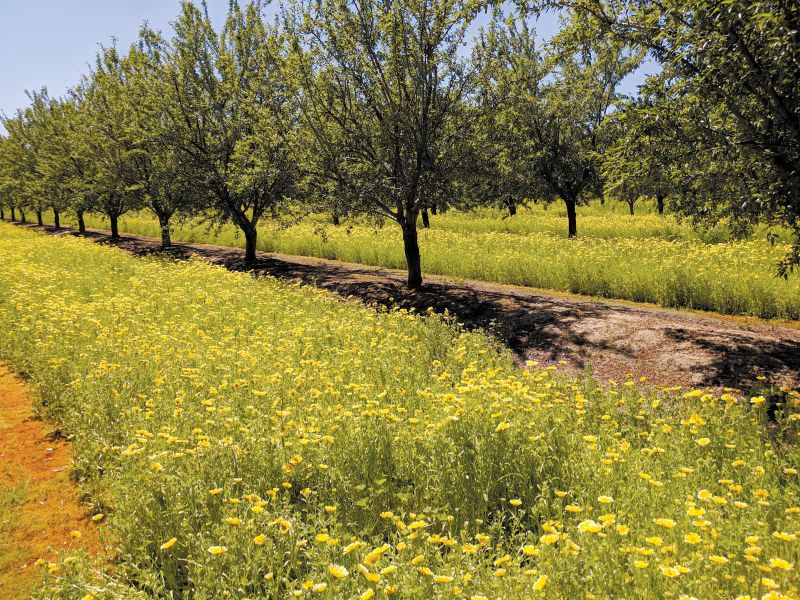
How General Mills opened the door to large-scale pollinator conservation on farms
In the wake of colony collapse disorder gaining national attention in the mid-aughts and the ensuing 2015 U.S. federal strategy on pollinators, some key staff at the food conglomerate General Mills wanted to help. Mace Vaughan and Eric Lee-Mäder, then co-directors of the Xerces Society’s Pollinator and Agricultural Biodiversity program, had been working with General Mills since 2012. They made the pitch that there needed to be a significant increase in the planting of pollinator habitat if food companies and farmers were going to make a meaningful difference in the fate of bees. As a result, in 2016, General Mills and the USDA’s Natural Resources Conservation Service pooled $4 million in funding for the Xerces Society to support the delivery of technical assistance to farmers with planting and protecting pollinator habitat. This was a breakthrough agreement that led to the hiring of many of my exceptional Xerces colleagues, known as NRCS partner biologists.
The next year, General Mills and three of its brands—Cascadian Farms, Cheerios, and Muir Glen—made a second substantial commitment in the form of an agreement with Xerces to plant pollinator habitat directly on their supplier farms. Since that time, thousands of acres of flowering habitat and miles of hedgerows have been planted across the vast acreage of General Mills farmland. This has been a major group effort. In the early years, Xerces staff including Stephanie Frischie, agronomist and native plant materials specialist, and Cameron Newell, Bee Better Certified program coordinator, brought well-researched and practical models for expanding pollinator habitat to this task.
Working with food suppliers for a large company can mean partnering with many farms over a huge area. Stephanie’s projects were on farms supplying oats for Cheerios in the Great Plains of the Dakotas, Saskatchewan, and Manitoba. Stephanie worked far and wide, designing sophisticated seed mixes for cover crops, pollinator meadows, and insectary strips, and had the seeds shipped to growers to plant. The work she and others did in that region led to the planting of more than 3,700 acres of flowering perennial pollinator habitat. For those who don’t spend a lot of time thinking in acres, Disneyland in California is about 100 acres. That means the farmers who Stephanie worked with planted pollinator habitat sufficient to cover 37 Disneylands. Now that would be a theme park I would love to visit!
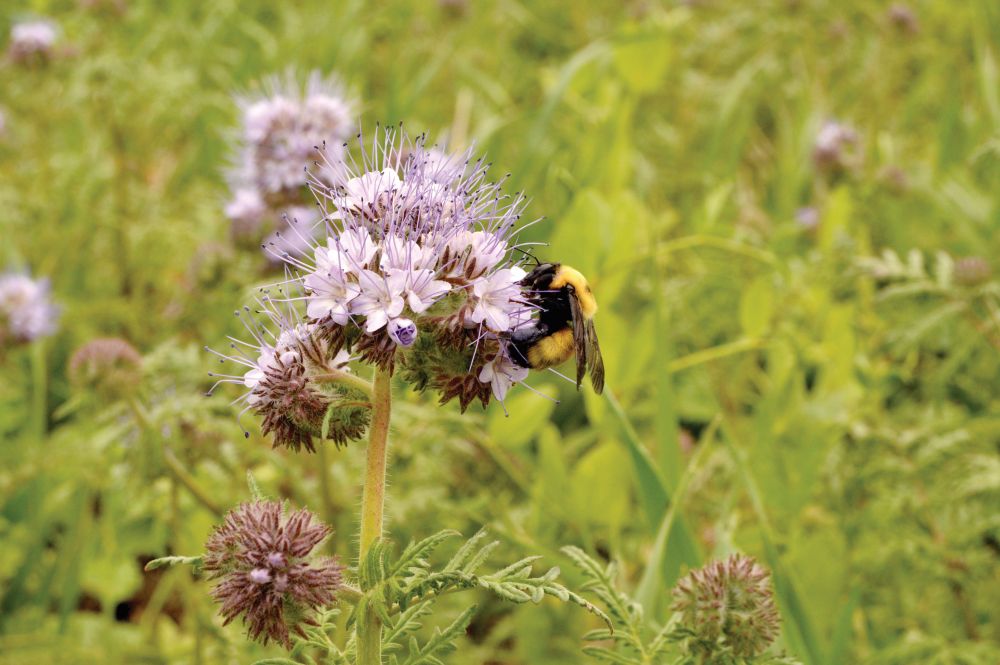
Diversifying conservation strategies for all crops and climates
The Living Farms team today works largely in the western United States, in tandem with growers of almonds, vegetables, and tomatoes in the Central Valley of California and tree fruits in the Columbia Basin of Washington and Oregon. These supply chains are a bit tricky. In the early years of the General Mills agreement, Cameron and I met with buyers—the staff at food companies who determine how much of a raw product to buy and where to source it— who connected us with processors, who in turn connected us with the farmers.
In the western states, planting rooted plants can work a lot better than seeds, especially during times of severe drought—which California was just recovering from in 2018—so Xerces started planting hedgerows. Lots and lots of hedgerows. As of early 2025, we have planted 31 miles of hedgerows with General Mills suppliers in California, Oregon, and Washington. At maturity, these hedgerows form dense walls, ten to fifteen feet tall, of flowers and nesting materials for bees. Imagine walking along them. If they were all lined up, it would take you more than ten hours at a brisk pace. You’d pass by elderberry, toyon, and ceanothus; milkweed, sage, and wild buckwheat. Pause a moment and you’d see syrphid flies, parasitoid wasps, long-horned bees, metallic green sweat bees, or my favorite, bee graffiti in the form of a perfect half-moon shape cut out of a redbud leaf, which says to me, “I, a boss leafcutter bee, was here.”
The Living Farms project continues to diversify, working with large companies and small farms that grow a range of crops, including lettuces, strawberries, blackberries, olives, beans, row crops, and more. This has led to planting another nine and a half miles of hedgerows and an additional sixteen hundred acres of other habitats. That’s sixteen more Disneylands!
Strong relationships remain the key to on-farm conservation
Through all of this, our relationship with growers is a critical element. On-farm conservation is entirely dependent on relationships, and we are deeply grateful for the hard work of the farmers and their employees, and for the staff at food companies and brands who continue to invest their time and efforts to help make our food system better for wildlife.
Trying to change our food system sometimes feels like throwing a flower petal at an elephant. I don’t think it notices. Other times, when I meet with a farmer next to their acres of flowering habitat or towering hedgerows, or talk with a sustainability manager at a mission-driven investment company, or see the number of habitat projects we plant growing rapidly, I feel better—more like we’ve draped a flower necklace over an elephant. And I think it likes the scent.
