
In fall 2025, approximately 470 Monarchs in the eastern U.S. were deployed with Blu+ transmitters by about 20 scientists and conservation professionals from Canada to Texas, including the Xerces Society’s own Dr. Ray Moranz, a pollinator conservation specialist based in Oklahoma. Most monarchs headed toward Mexico to spend the winter, but of course many succumbed along the way due to various causes.
Out of this cohort of tagged monarchs that made it to the overwintering colonies in Mexico and spent the winter there, female monarch XSTI009 (where the X stands for Xerces) appears to be the first to make it back to the United States. She crossed the Rio Grande into Texas on Saturday afternoon, March 14, 2026. Incredibly, by 6PM the following day she had flown to the eastern edge of metro Houston. That means she flew about 320 miles between Saturday afternoon and Sunday evening!
“When they fly 300 miles in a day, it is because they are taking advantage of strong winds that are blowing in the direction the monarchs want to go,” said Moranz. “This monarch wanted to go north, and there were strong southwest winds all day along the Texas coast carrying her to the northeast.”
Moranz initially encountered XSTI009 last fall on his farm just outside of Stillwater, Oklahoma, and can still recall the experience.
“She was in pristine condition, weighing in at 558 milligrams, with a forewing length of 51.92 mm and a noticeably fat abdomen,” said Moranz. “I think all the nectar plants I planted for her and her friends gave them a boost before they headed south.” He snapped a few photos of this beautiful monarch before her release.
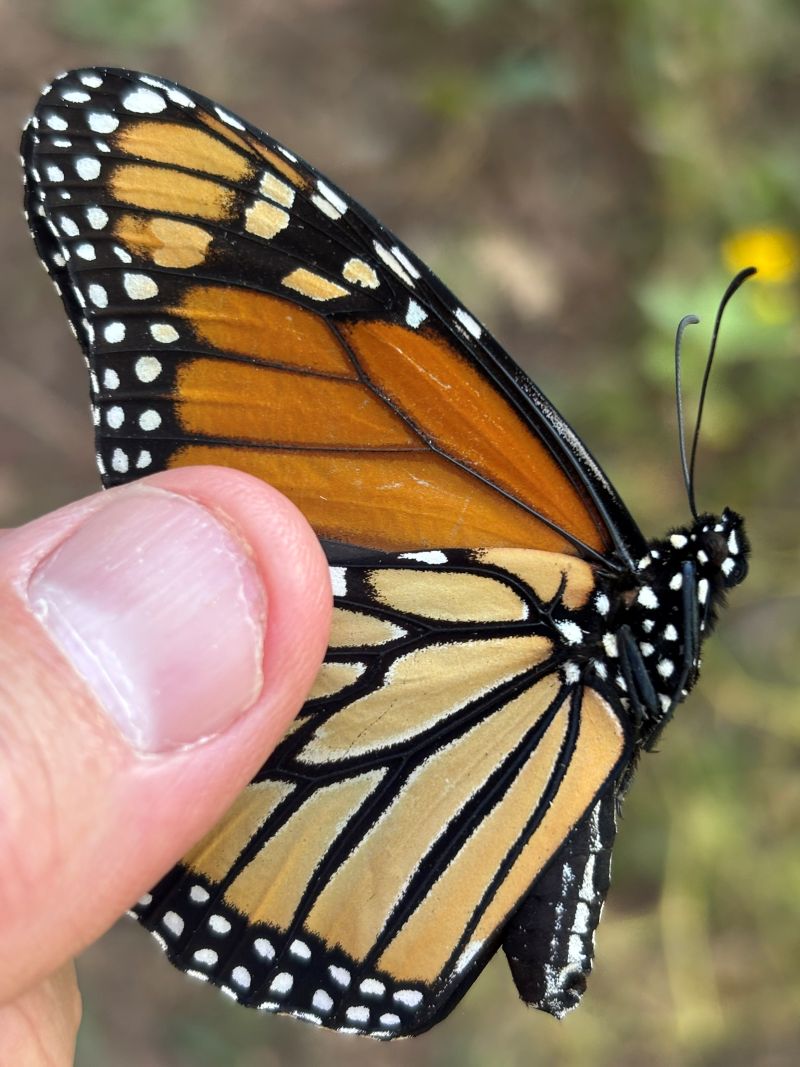
Initially, strong south winds prevented her from flying south for the first 10 days after release. But on October 19, she sailed through Oklahoma City and nine days later through San Antonio, TX. She crossed the Rio Grande into Mexico on October 29 or 30 and was first detected at the El Rosario Monarch Overwintering Sanctuary on November 19, where she spent the winter with millions of her friends and relatives.
Since XSTI009 departed the overwintering colony on the afternoon of March, she has flown at least 785 miles in just 6 days.
“The Project Monarch app tells me that she is now about 30 miles east of Houston. Hopefully she has hunkered down, because a cold front came through overnight and it is only 46 degrees there,” said Moranz.
Anyone can view the location of tagged monarchs and track their journey by downloading the Project Monarch apps available for iPhone and Android. To learn more about the technology and related projects, check out Monarch Joint Venture’s presentation, The Science of Radio Tagging Monarchs.


Deborah Seiler joined the Xerces Society in 2021 as director of communications, bringing over ten years of experience representing environmental and research institutions. She has previously led invasive species campaigns in Wisconsin, coastal science communications with California Sea Grant, and served as CCO of Illinois Extension. Deborah attended University of California-Davis and University of Wisconsin-Madison, where she studied science communications, environmental behavior, and digital media.

Ray works to conserve pollinators on rangelands in the central U.S., and he also serves as a Partner Biologist to the USDA’s Natural Resources Conservation Service’s (NRCS) Central National Technology Support Center in Fort Worth, TX. He is based at the NRCS Field Office in Stillwater, Oklahoma. One focus of his work is to assist in the planning and implementation of monarch butterfly conservation efforts in the south central U.S.. Ray began studying the effects of fire and grazing on prairie plant and butterfly communities in 2004, and earned his Ph.D.