


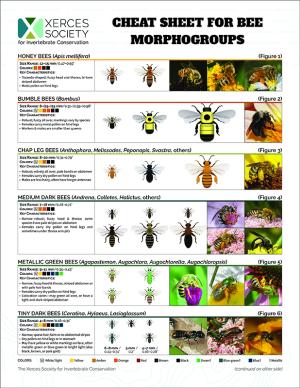
Bees are difficult to identify to species or family without having pinned specimens. But bee richness at a site can be measured by identifying bees to groups based on their morphology (also known as morphogroups), which use characteristics that can be seen in the field to categorize bees.
This cheat sheet can be used in conjunction with our Citizen Science Monitoring Datasheet - Bees, in addition to our other bee richness monitoring resources, to track the diversity of native* species at a site over time.
*Note that honey bees are not native to North America. When sampling for bees, distinguishing between honey bees and native bees is the most important observation one can make.
Additional Bee Richness Monitoring Resources:
- Citizen Science Monitoring Datasheet - Bees
- Streamlined Bee Monitoring Protocol for Assessing Pollinator Habitat and Streamlined Bee Monitoring Protocol Datasheets
- Citizen Scientist Pollinator Monitoring Guide: California
- Citizen Scientist Pollinator Monitoring Guide: Pennsylvania
- Maritime Northwest Citizen Science Monitoring Guide
- Upper Midwest Community Science Pollinator Monitoring Guide: Native Bees
- Types of Bees Visiting Watermelon in the East
- Types of Bees Visiting Watermelon in the West
Download as PDF
(1.25 MB)
Serial Number
26-016
Version Number
01